
I’ll be honest with you from the start. I hate marketing too.
I’d far rather just do the work I’m good at, for clients I get on with, who appreciate what I do as much as I appreciate them. Sitting down to “promote myself” is the part I’d happily skip forever.
It’s taken me years to accept a simple thing: if you want to help more people, and build the kind of life you actually deserve, marketing isn’t optional. It sits right next to sales as one of those necessary parts of running your own practice. You don’t have to love it. You just have to find a version of it you can live with.
This article is for the therapist, counsellor or coach who is genuinely good at the work, but freezes at the thought of putting themselves out there. Let’s talk about why that happens, and what actually helps.
Why marketing feels so hard for therapists
When I sit with my own resistance, here’s what I find underneath it.
There’s imposter syndrome, the quiet worry that I’m not as good as people think, and that promoting myself will somehow expose that. There’s a fear of coming across as pushy or disingenuous, which feels especially wrong when your whole working life is built on being genuine. And there’s the worry of looking like everyone else online, all saying the same polished things in the same polished way.
Then there’s the big one. The doubt that you’ve got anything worth saying at all. The sense that nobody’s really interested in what you do.
If any of that lands for you, please know it’s incredibly common, especially among thoughtful people in the helping professions. The very sensitivity that makes you good with clients is the thing that makes self-promotion feel so uncomfortable. You’re attuned to how things land, so the idea of broadcasting feels jarring.
None of this means you’re bad at marketing. It means you care about being honest. That’s a good starting point, not a flaw.
It’s not always shyness, the confident ones stall too
Here’s something that surprised me.
I work with a coach who has skill, years of experience, and testimonials coming out of their ears. They come across as confident, clear, sure of what they want. On paper, exactly the sort of person who should be thriving.
And yet the business isn’t going where it should. For all that confidence, they don’t push themselves in the directions that would make more of their talent. All that proof of how good they are, those glowing testimonials, sits quietly unused.
I tell you this because it’s easy to assume marketing resistance is just shyness, something only the timid struggle with. It isn’t. It can hide behind plenty of outward confidence. The gap between knowing your worth and acting on it is wider, and more common, than most people admit.
The cost is quiet, which is what makes it so easy to ignore. No dramatic failure. Just clients you could have helped, slowly drifting to whoever was easier to find.
The reframe that finally helped
For a long time I thought of marketing as showing off. Standing on a chair, waving my arms, asking to be noticed. No wonder I hated it.
What changed things for me was a simpler way of looking at it. Marketing is just the bridge between the work you love and the people who need it. If you stay invisible, the people who could really benefit from you never get the chance. They end up with someone else, or with no one.
Put like that, it stops being about ego. It becomes part of the care. Letting the right people find you is a kindness to them, not a performance for you.
I won’t pretend this made me love it. But it moved marketing from “the thing I’m avoiding” to “the thing I do so I can keep doing the work I love.” That shift, for me, was everything.
The barrier is bigger in your head than in reality
Here’s the part I most want you to hear.
I still feel resistance, even now. I’d be lying if I said I’d cracked it completely. But what I’ve learned is that the dread is almost always worse than the doing.
When you finally push past that first barrier, the actual process of marketing yourself, putting a few honest words out, sharing what you know, is far easier and more painless than you ever imagined. The story your mind tells beforehand is dramatic. The reality is usually small, quiet and quite undramatic.
So if you’re stuck, don’t try to fix the whole thing at once. Just take one small step that’s too small to be scary:
- Write one short post about a question clients often ask you.
- Add a proper page to your website for the area you work in, so you start to get found on Google as a therapist.
- Ask one happy client if they’d mind leaving a short review.
That’s it. The aim isn’t a marketing machine. It’s to prove to yourself that stepping out is survivable, and honestly, a bit dull once you’re doing it. That’s the feeling you’re after.
What marketing that suits a quiet person actually looks like
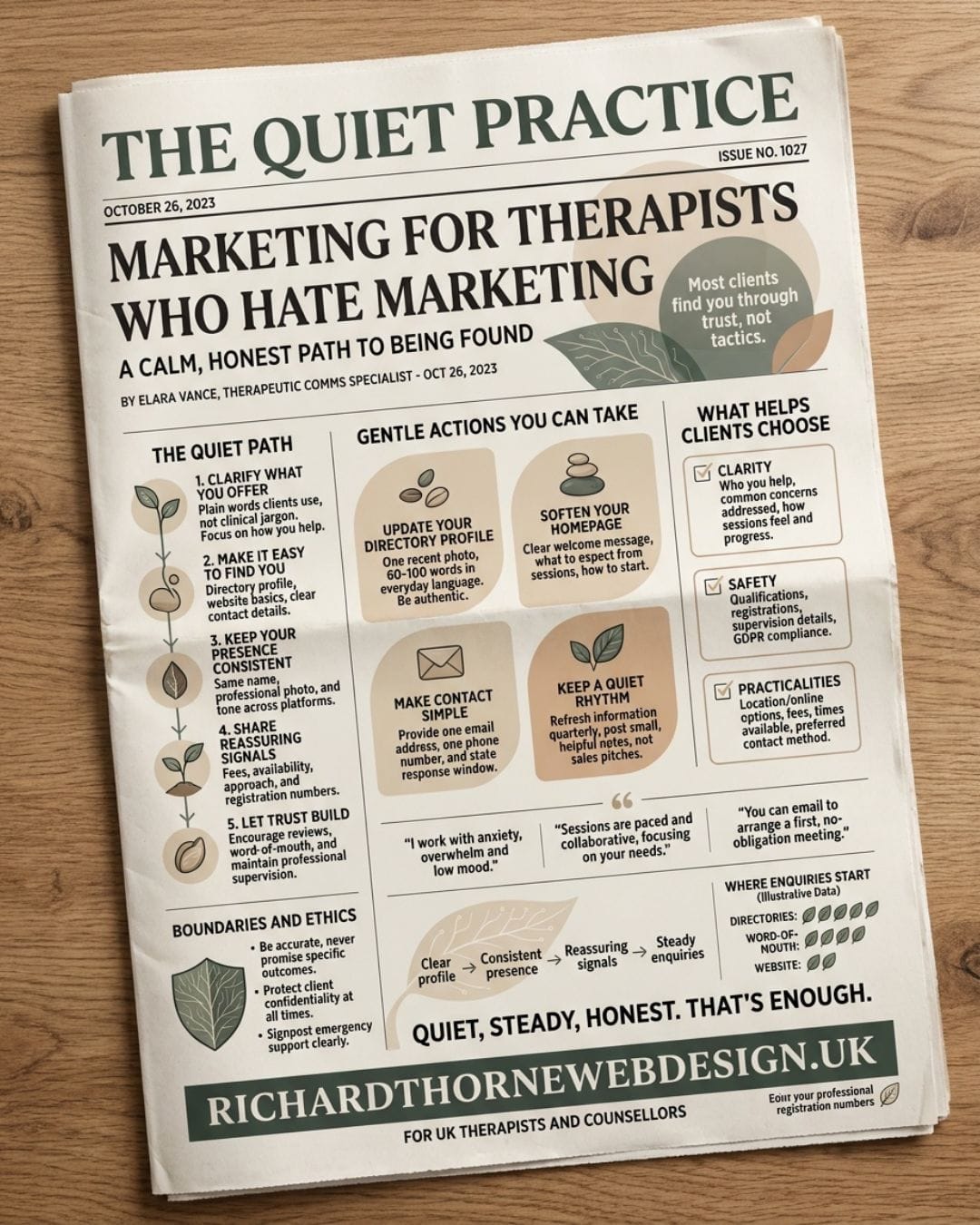
You don’t have to become loud to be found. The version of marketing that works for thoughtful people is steady, honest, and unmistakably in your own voice.
That last bit matters most. The reason so much marketing feels fake is that it doesn’t sound like the person behind it. It sounds like an advert. When your words sound like you, the warmth you bring to your clients comes through, and that’s what the right people respond to.
Here’s the quiet truth I’ve landed on. The marketing a reluctant therapist can genuinely live with is the marketing they don’t have to wrestle with alone. It’s the words they would have written themselves, if the self-doubt, the reluctance, or simply the lack of time weren’t in the way.
These days that can mean having content created for you, or shaped with the help of AI but kept in your own language and your own tone. Done properly, it sounds like you, because it came from you, just without the evenings spent staring at a blank screen. The outcome is the thing to focus on: being found by the people who already need you, in words that feel like yours, without the dread.
That’s the approach I take with my own clients, and increasingly the help I’m building for therapists who want to be seen without having to become a marketer to do it.
A gentle next step
If you’ve read this far, you probably care a great deal about your work and very little about shouting about it. That’s exactly the kind of person the internet should be better at finding, and usually isn’t.
You don’t need a big strategy or a personality transplant. You need one honest step, then another, in a voice that’s actually yours.
If you’d like a hand with that, I’m always happy to have a quick, no-pressure chat. No jargon, no hard sell, just a friendly conversation about how to help the right people find you. You can book a free 30-minute chat whenever it suits.
(For a bit of background: RTWD was named Best Web Design Service in Somerset at the Southern Enterprise Awards 2021. Honestly though, the part I care about is helping good people get found.)
Frequently asked questions
Do therapists really need to do marketing?
In almost all cases, yes, if you want a steady flow of the right clients. Word of mouth is wonderful, but it’s unpredictable, and it tends to dry up exactly when you need it most. There are well over 18,000 therapists listed on directories like the BACP Therapist Directory and Counselling Directory alone, so being findable, and standing out as yourself, genuinely matters. Marketing simply means making it easier for the people who already need your help to find you. It doesn’t have to be loud, frequent, or salesy. A clear website, a presence where your future clients are looking, and a few honest words about what you do will carry you a long way. Think of it as part of the care you offer, not a separate, grubby task bolted on.
What’s the easiest way for a therapist to market themselves?
Start with the things that work quietly in the background. A clear, well-built website that explains who you help and where you’re based does a lot of the heavy lifting without you having to do anything daily. Add a Google Business Profile so you show up in local searches, and gather a few genuine reviews from clients who’ve appreciated your work. These don’t require you to post constantly or perform online. Once that foundation is in place, you can add the occasional honest article or post if and when you feel like it. The easiest marketing is the kind that keeps working while you get on with seeing clients.
How do I market my practice without feeling pushy or salesy?
Lead with honesty and usefulness rather than persuasion. If everything you put out is genuinely meant to help, sharing what you know, answering common questions, being clear about who you’re a good fit for, it stops feeling like selling. The pushy feeling usually comes from copying tactics that don’t suit you: false urgency, hype, pressure. Drop all of that. Write the way you’d speak to one person you respect. Therapists are trained to spot inauthenticity, and so are your potential clients. The warm, plain, honest approach isn’t just more comfortable for you, it’s the only one that actually works with this audience.
I’m not confident online, where do I even start?
Start far smaller than feels worthwhile. Pick one tiny action: a single short post answering a question clients ask you a lot, or finally writing the page on your website about the area you cover. The goal of that first step isn’t results, it’s proof to yourself that stepping out is survivable and, frankly, a bit ordinary once you’re doing it. The dread beforehand is nearly always worse than the doing. Once you’ve done one small thing and the sky hasn’t fallen in, the next step gets easier. Confidence comes from the doing, not before it.
Can I get someone else to do my marketing in my own voice?
Yes, and for a lot of therapists this is the answer that finally unlocks things. If the blocks, the reluctance or simply the lack of time are stopping you, having content created for you, or shaped with AI but kept in your own language, removes the hardest part. Done well, it sounds like you, not like a generic advert. You stay in control of the tone and the message, you just don’t have to spend your evenings wrestling with a blank screen. The result is that the right people find you, in words that feel genuinely yours, without you having to become a marketer to make it happen.