
TL;DR: The best SEO keywords for therapists are the everyday words a worried person types into Google, not clinical terms. People search the problem and the feeling, like “help with panic attacks” or “why do I feel anxious all the time”, often with their town added. Match those phrases on your pages and the right clients start to find you.
A while back I did keyword research for a client. I pulled the actual numbers, found the phrases real people were typing, and handed over a short list of words to weave into their pages. Sensible, attainable words that people in their area were genuinely searching for.
They ignored most of it. The site went live full of long, wordy sentences, all about them, their training, their philosophy, their approach. Lovely writing in its way. But not a single phrase a worried person would ever type into Google.
I see this a lot. So this article is about the words themselves. Which ones bring the right people to your door, which ones quietly keep you invisible, and how to tell the difference without learning a thing about technical SEO.
Why the words on your page matter more than your training does
Here is the uncomfortable bit. Google doesn’t care how good a therapist you are. It can’t tell. What it can do is match the words someone types into the search box against the words on your page, and show the closest fit.
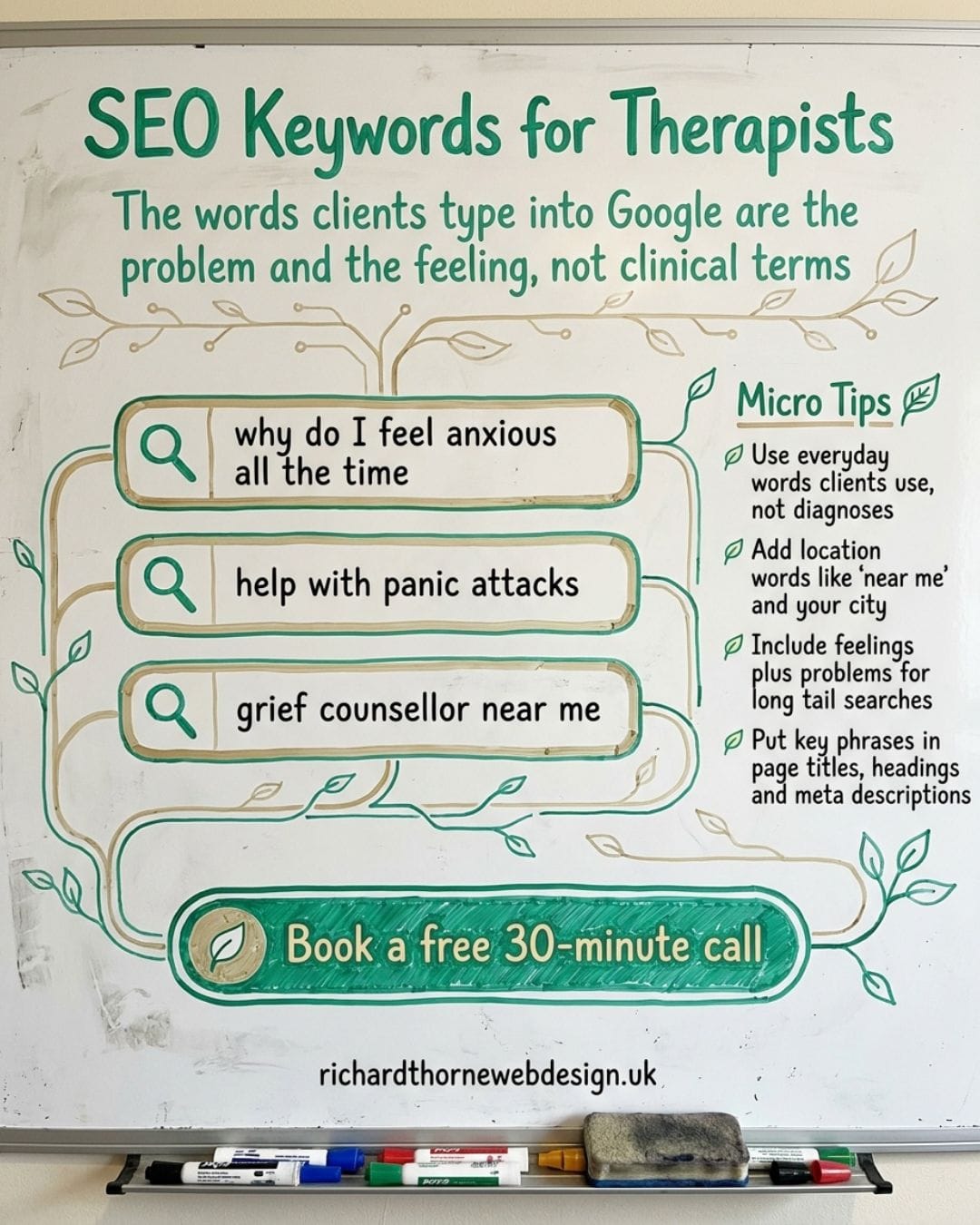
So if someone searches “help with anxiety in Wells” and your homepage talks about your “integrative, person-centred approach to psychological wellbeing”, Google struggles to connect the two. You and that person are talking about the same thing. You’re just using completely different words for it.
That’s the heart of it. The words on your site need to be the words your future clients actually use, not the words you were trained in. A page written to impress other therapists won’t get found by the people who need one.
This is where a lot of good therapists go wrong, and it’s an easy fix once you see it.
The biggest keyword mistake therapists make
When a therapist does start thinking about keywords, the wrong turn is nearly always the same one. They go too broad.
Often it comes from a well-meaning friend. Someone who “knows a bit about marketing” tells them to target “counselling” or “therapy” or “psychotherapist”. Big, obvious words. They sound right.
The problem is you’re now competing with every counsellor in the country, plus the directories, plus the NHS, plus Wikipedia. A solo therapist has no realistic chance of ranking for “counselling”. It’s like opening a small shop and trying to outrank Amazon for the word “shopping”.
When a client suggests words like that, I gently steer them somewhere smaller and far more winnable:
- Too broad: counselling, therapy, anxiety
- Just right: anxiety counselling in Glastonbury, help with panic attacks Somerset, grief counsellor near me
Those longer, more specific phrases are called long-tail keywords. Fewer people search them, yes. But the few who do are close to booking, they’re in your area, and you can actually rank for them. Ten of the right visitors a month beats a thousand who were never going to call.
What your future clients are actually typing
Here’s something the keyword research shows again and again, and it surprises most therapists.
People don’t search using the name of your modality. Almost nobody types “psychodynamic counsellor” or “CBT practitioner”. They search for the problem they’re facing, in plain, human words. And often they’re not even adding a place yet.
They’re typing things like:
- “why do I feel anxious all the time”
- “can’t stop crying for no reason”
- “how to deal with grief”
- “why am I so angry lately”
Look at those. They’re not looking for a therapist yet. They’re looking for understanding. They want to know what’s happening to them and why they feel the way they do. The decision to find someone to talk to often comes later, once they trust the source that finally explained it to them clearly.
That’s a real opportunity. If your site has a calm, honest page that answers “why do I feel anxious all the time” in plain English, you meet that person at the exact moment they’re searching, often late at night, often a bit frightened. By the time they’re ready to book, you’re already the voice they trust.
| What therapists write | What clients actually type |
|---|---|
| Integrative psychotherapy | help me stop overthinking |
| Person-centred counselling | someone to talk to about my marriage |
| Trauma-informed practice | why do I feel numb all the time |
| Bereavement support services | how to cope after losing my mum |
The left column is accurate. The right column is what gets typed into Google at 11pm. Your pages need both, but they have to lead with the right-hand column.
The two things that make a keyword right: place and feeling
If I had to boil the whole thing down, getting your keywords right comes down to two ingredients.
The first is place. Most therapy is local, and so is a huge slice of searching. Around half of all Google searches are looking for something nearby, according to BrightLocal’s local search research. People want someone they can sit in a room with, or at least someone in their own country and time zone. So your town, your county, the nearby towns you’d happily travel to, all of that needs to be clearly on the page. Not buried in the footer. Properly written into the content. It’s the same thinking behind the one page most therapy websites are missing: a dedicated page for each place you want to be found in.
I’ll be honest with you here. For years, even I didn’t push location pages the way I should have. The conversation with clients was always about the therapist and the services, never about the specific places they wanted to be found in. The thinking has moved on, and location is now one of the first things I look at. If you want the fuller picture of how Google ranks nearby practices, my guide to local SEO for therapists walks through it.
The second ingredient is feeling. This is the human half, and it matters just as much. The words need to match how someone actually feels when they’re searching. Someone in distress at the kitchen table doesn’t type “anxiety disorder treatment options”. They type “I can’t calm down” or “help, I think I’m having a panic attack”. Write for that person. Use their words, gently, and they’ll feel understood before they’ve even made contact.
Place tells Google where to show you. Feeling makes the right person stop scrolling and read. You need both.
A simple way to find your keywords (and whether you even need to bother)
You don’t need fancy tools for this. Here’s a plain four-step version you can do at your kitchen table.
- List the real problems people bring you. Write them in your clients’ words, not clinical ones. “Can’t sleep with worry”, “dreading going to work”, “lost my mum and can’t function”. The exact phrases you hear in the room.
- Add your places. Your town, plus the two or three nearest towns you serve. “Anxiety counselling Street”, “grief support near Glastonbury”.
- Sanity-check them. Type each one into Google. Look at the autocomplete suggestions that drop down, and the “People also ask” box. That’s free, real data showing you how people genuinely phrase things.
- Weave them in naturally. One clear page per main problem, and a proper page for each location you want to be found in. Write like you talk. Never stuff a keyword in where it reads oddly.
Now, the honest caveat, because I’d rather tell you the truth than sell you something you don’t need.
If your website is really just a brochure, somewhere to send people who already found you through a directory, a referral, or word of mouth, then you may not need to worry about SEO much at all. As long as the site reads well, feels like you, and makes it easy to get in touch, it’s doing its job. There’s no point chasing Google rankings you don’t actually need.
But if you want your website to bring you new clients on its own, quietly, while you’re with someone else or asleep, then the words are where it starts. Get those right and everything else has something to build on. If you’d like the wider view, my guide to getting found on Google as a therapist pulls the pieces together.
Frequently asked questions
What are the best SEO keywords for therapists?
The best keywords are the everyday phrases your future clients actually type, not clinical terms. That usually means the problem someone is facing combined with your location, such as “anxiety counselling in Bristol” or “bereavement support near Taunton”. These specific, local phrases are far easier to rank for than broad words like “counselling” or “therapy”, and the people searching them are much closer to booking. Avoid leading with your therapy modality. Almost nobody searches “psychodynamic counsellor”. They search how they feel and where they are. Make a clear list of the problems clients bring you, in their words, add your town and nearby towns, and build your pages around those phrases.
Should I use my therapy modality as a keyword?
Mostly, no, at least not as your main keyword. Real searches show that very few people look for a therapist by modality. They don’t type “CBT therapist” or “integrative counsellor”. They type the problem they’re struggling with, like “help with panic attacks” or “why do I feel anxious all the time”. So your modality belongs on the page, it builds trust once someone is reading, but it shouldn’t be the word you’re trying to rank for. Lead with the problem and the feeling, then explain your approach further down for the people who care about it. A small number of clients do search by modality, so it’s worth a mention, just don’t make it the headline.
What is a long-tail keyword and why does it matter for therapists?
A long-tail keyword is a longer, more specific search phrase, like “grief counsellor for sudden loss in Glastonbury” rather than just “counselling”. Fewer people search these phrases, but the ones who do are specific about what they need and often ready to act. For a solo therapist, long-tail keywords are where the real opportunity sits. You can’t realistically outrank big directories and the NHS for a broad word like “therapy”, but you absolutely can rank for a precise local phrase that those big sites don’t bother targeting. Ten of the right visitors a month, people in your area with the exact problem you help with, is worth far more than a thousand random visitors who were never going to get in touch.
How many keywords should a therapy website target?
There’s no magic number, and chasing dozens of keywords usually backfires. A better way to think about it is one clear page per main thing you want to be found for. So you might have a page for anxiety, one for grief, one for relationship issues, plus a proper location page for each town you serve. Each page focuses on one problem and one place, written naturally. That way Google has a specific, obvious page to show for each type of search, instead of one cluttered page trying to be everything. Most therapists do well with a handful of focused pages rather than a long, scattered keyword list. Start with the two or three problems you most want more clients for, get those pages right, then build from there.
Do I still need keywords if I’m listed on directories like BACP or Psychology Today?
It depends on where you want your clients to come from. Directories like BACP and Psychology Today do bring enquiries, and for some therapists that’s enough. If your practice is full from directory listings and referrals, your own website can simply be a calm, well-written place that reassures people once they find you. But there’s a catch with relying only on directories: you’re one of dozens of profiles on a page you don’t control, and you’re paying to be there. Your own website, ranking for the right local phrases, is the one place online that’s entirely yours and works for you around the clock. Many therapists use both: directories for reach now, and their own site building steadily so they depend on the directories less over time.
How do I find out what my clients are searching for?
Start with what you already know. The phrases your clients use in the room, in their first emails, in that nervous first phone call, those are your keywords. Write them down in their words. Then type a few into Google and watch the autocomplete suggestions appear, and read the “People also ask” box underneath the results. Both are free and show you exactly how people phrase things. If you want to go deeper, free tools like Google Trends or a keyword research session will show you rough search numbers. But honestly, listening closely to how your clients describe their own struggles will get you most of the way there. They’re telling you your keywords every day. The trick is to use their language on your website rather than your own.
If reading this has made you realise your website is speaking your language rather than your clients’, that’s exactly the gap I help close. I’m building GrowPath Studio, a service that gets therapists found locally on Google using proper location pages and the words real clients actually search for. If you’d like to be found by the people in your area who already need you, join the GrowPath wait-list. No pressure, no jargon, just a quiet, honest way to become more visible to the right people.
Richard Thorne is a web designer based in Glastonbury, Somerset, specialising in websites for therapists and counsellors. RTWD was named Best Web Design Service in Somerset at the Southern Enterprise Awards 2021.