
TL;DR: Google ranks individual pages, not whole websites. To show up for “counsellor in your town”, you need a dedicated location page: one service, one town, clearly named. Most therapy sites only have a general services page, so Google has nothing specific to rank. Here is how to fix that.
A lot of therapists tell me the same thing. They have a website, it looks lovely, it took real effort to put together, and yet when they search for “counsellor” in their own town, they are nowhere to be seen.
It usually isn’t about the quality of the site either. In almost every case, the same single thing is missing. It’s a page. One specific page that tells Google exactly who you help and where. Most therapy websites don’t have it, and that one gap quietly keeps them out of local search.
This article explains what that page is, why it matters so much, and how to put one together. None of it is technical. You can check whether your site has the problem in about ten minutes.
Google doesn’t rank websites, it ranks pages
Here is the part that surprises people. Google doesn’t really rank websites. It ranks individual pages. For every search someone types, it goes looking for the single page that most clearly matches that exact query, then shows that page.
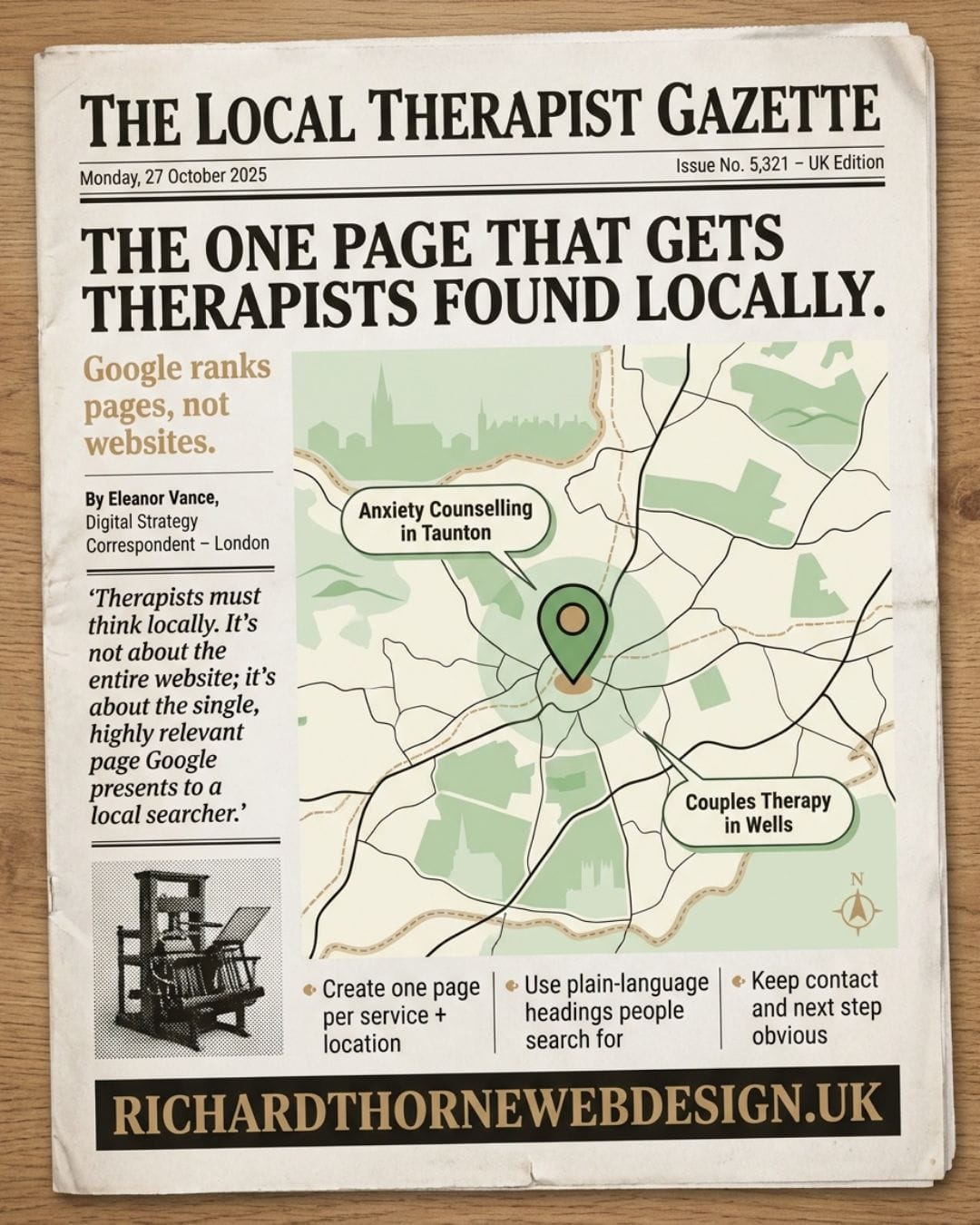
So when someone in your area types “anxiety therapist Taunton” or “bereavement counsellor near me”, Google isn’t asking “is there a good therapy website nearby?” It’s asking “is there a page that is clearly, specifically about anxiety therapy in Taunton?” If the closest thing on your site is a general “Services” page that mentions several things in broad terms, Google has nothing strong to point to. It can see you offer therapy. It can’t see that you are the obvious answer to that particular search.
That’s the difference between having a website and being found. A beautiful homepage that tries to cover everything sends a blurry signal. A focused page sends a sharp one. If you want the wider picture on this, I’ve written separately about how Google decides which local results to show first.
What a location page actually is
The page Google is looking for is a location page. That’s a dedicated page about one service, in one place. Not a list of everything you do. One service, one location, made obvious.
A counsellor in Taunton who works with anxiety might have:
- A page called “Anxiety Counselling in Taunton”
- A page called “Bereavement Support in Somerset”
- A page called “Couples Therapy in Taunton”
Each one gives Google an unambiguous signal: this page is about this thing, in this place. That clarity is what gets you into the local results. It’s also, honestly, better for the person reading. Someone anxious and searching on their phone lands on a page that speaks directly to their situation and their town, rather than a general overview they have to wade through.
I’ve seen how fast this can work. When we built locally optimised location pages for my own business, one for each town I serve, the pages for Glastonbury, Street, and Wells were indexed and sitting on page one of Google in less than twenty-four hours. Not weeks. A day. That isn’t typical for every keyword, and competitive city searches take longer, but it shows how much Google rewards a page that answers a local query clearly when there isn’t much focused competition for it. For a lot of therapist searches, there isn’t.
The three things that page must get right
A location page only works if Google can read the signal clearly. Three things do most of the heavy lifting, and they take minutes to check.
- The page name and address. The page should be named after your main service and your town, for example “Anxiety Counselling in Wells”. The web address should reflect it too, something like
/anxiety-counselling-wells. - The page title. This is the text that shows in the browser tab and as the blue link in Google. Write it as “Service + Location | Your Name”, for example “Anxiety Counselling in Wells | Jane Smith Counselling”. This is one of the strongest signals you can send.
- The main heading. The big heading at the top of the page (the H1, in web terms) should include both your service and your location in plain language, not a vague welcome message.
If any of those three is missing, that’s the most impactful thing you can add to your website. You don’t need to rewrite the whole site. You need to make one page unmistakably about one service in one place. It sits alongside the other basics of getting found on Google as a therapist.
Why one general Services page quietly fails you
Most therapy sites have a single “Services” page listing everything: individual counselling, couples work, anxiety, bereavement, online sessions, all in broad terms. It feels efficient and tidy. The trouble is that it competes with itself.
When one page tries to rank for five different things, it ranks strongly for none of them. Google can’t tell what it’s really about. A separate, focused page for each service lets you write properly about that one thing, use the words your future clients actually type, and give Google a clean signal. You’re not gaming anything by doing this. You genuinely do offer those services, so each deserves its own honest, well-written page.
How many pages do you need, and where to start
Be realistic and be genuine. The honest version of this is a focused page for each service and each location you actually work in. If you offer anxiety counselling and couples therapy, and you see clients in two towns, that’s a small set of clearly named pages, not one catch-all.
The temptation is to spin up dozens of thin, near-identical pages with the town name swapped out. Don’t. Google spots that quickly, and it reads as exactly what it is. Each page should be genuinely written for the place and the service, with real, specific content.
If you’re starting from scratch, start with your home town. Build one strong page for your main service in the town where you’re actually based, get it right, and let it prove itself. You can add more once you’ve seen it work. A location page also works best alongside a well-kept Google Business Profile, which is the other half of showing up in local search.
Frequently asked questions
Why isn’t my therapy website showing up on Google?
The most common reason is that your site doesn’t have a page clearly focused on your service and location. Google ranks individual pages, not whole websites, and it looks for the page that best matches each search. If your site only has a general “Services” page, Google has nothing specific to rank for searches like “counsellor in your town”. Adding a dedicated location page, named after your main service and your town, with a matching page title and heading, is usually the single biggest improvement you can make.
What is a location page?
A location page is a single web page focused on one service in one place, for example “Anxiety Counselling in Taunton”. Rather than listing everything you offer, it concentrates on one thing in one area. This gives Google a clear, unambiguous signal about what the page is for, which makes it far more likely to appear when someone nearby searches for that exact service. It also reads better for the client, who lands on a page that speaks directly to their situation.
How many location pages should a therapist have?
Enough to genuinely reflect the services and areas you work in, and no more. If you offer two services across two towns, a small set of focused, clearly named pages is right. Avoid creating lots of thin, near-identical pages with only the town name changed, as Google treats that as low quality. Each page should be genuinely written for its service and place. Start with one strong page for your main service in your home town, then add more once it proves itself.
How quickly can a location page start ranking?
It varies, but a focused page for a local search with little competition can rank surprisingly fast. When I built location pages for my own business, the pages for Glastonbury, Street, and Wells reached page one within twenty-four hours. Competitive city searches take longer, often weeks or months, and results depend on how established your site is. But for many local therapist searches there’s little focused competition, so a clear, well-built page can move quickly.
Do I need a separate page for each service?
Yes, if you want each service to rank. A single “Services” page that lists everything competes with itself and ranks strongly for nothing, because Google can’t tell what it’s mainly about. A separate page for each service lets you write properly about that one thing, use the specific words clients search for, and send Google a clean signal. You genuinely offer those services, so giving each its own honest, well-written page is accurate as well as effective.
Getting your location pages built
Getting these pages right is exactly what GrowPath does. GrowPath is my local SEO service for therapists and small businesses: I build the focused, properly optimised location pages that get you found in your area, so you don’t have to work out the technical side yourself.
GrowPath is opening for new clients now. Joining the wait-list gets you founding-client pricing and a free local visibility check, so you’ll know exactly where you currently stand in Google for your town before we start.
Richard Thorne is a web designer based in Glastonbury, Somerset, specialising in websites and local SEO for therapists and counsellors. RTWD was named Best Web Design Service in Somerset at the Southern Enterprise Awards 2021. GrowPath is a local SEO service from RTWD.