
You’ve done the research. You’ve Googled “web designer”, looked at a few websites, maybe even asked in a Facebook group. And you still have no idea what you should be paying.
The quotes are all over the place. One designer wants £3,000 upfront. Another is offering £10 a month but it looks like a DIY template. Someone else is quoting £89 a month and you’re not sure what that actually includes. The whole thing feels like a minefield — and the worry underneath it is a familiar one: what if I get this wrong and waste money I can’t afford to waste?
That’s a completely reasonable thing to feel. Web design pricing in the UK is genuinely confusing, and not many people in the industry are honest about why.
I’ve been building websites for therapists and small businesses for years, and pricing is the question I hear most. So here’s what I’d tell you if you asked me directly.
Why website pricing is so confusing
The UK web design market has no standard pricing, which is why quotes vary so wildly. A freelancer working from h
ome has almost no overheads. A city agency has a full team, an office, account managers, and ongoing costs that all have to be covered somewhere.
I once had a client come to me after working with an agency in Somerset that was charging £100 an hour. I understand agencies have overheads — but at that rate, a straightforward five-page website puts a professional online presence out of reach for most therapists before they’ve even started.
At the other end, you’ll find website builders for a few pounds a month that promise everything and deliver a generic-looking page that ranks nowhere on Google. Neither extreme serves most small businesses well, which is why understanding what sits in between matters.
What actually goes into a pay monthly website price
When a web designer quotes you a monthly fee, that figure covers more than most people realise.
Before a single page is built, there’s real thinking to do. What’s the goal of each page? How do visitors move through the site? Where should the contact form sit — and should it be a contact form at all, or a direct booking link? What calls to action genuinely work for a therapy audience? These decisions shape whether a website actually brings in enquiries or just sits there looking tidy.
Then there’s on-page SEO — working out what phrases potential clients are actually searching for and structuring content around those. Getting this right from the start is significantly easier than trying to fix it later.
Beyond the build itself, a proper pay monthly plan includes the ongoing infrastructure your site needs:
- Domain registration and hosting
- SSL certificate (the padlock that tells visitors your site is secure)
- WordPress core, theme, and plugin updates
- Security monitoring and malware scanning
- Offsite backups, so a broken or hacked site can be restored quickly
- Ongoing support when you need changes or something goes wrong
That’s a significant amount of work and responsibility to carry for £59 to £129 a month. When you add it up, a pay monthly plan often costs less than sourcing all of these things separately — let alone a full build upfront.
What does pay monthly website design actually cost in the UK?
Here’s an honest breakdown of what different price points actually deliver.
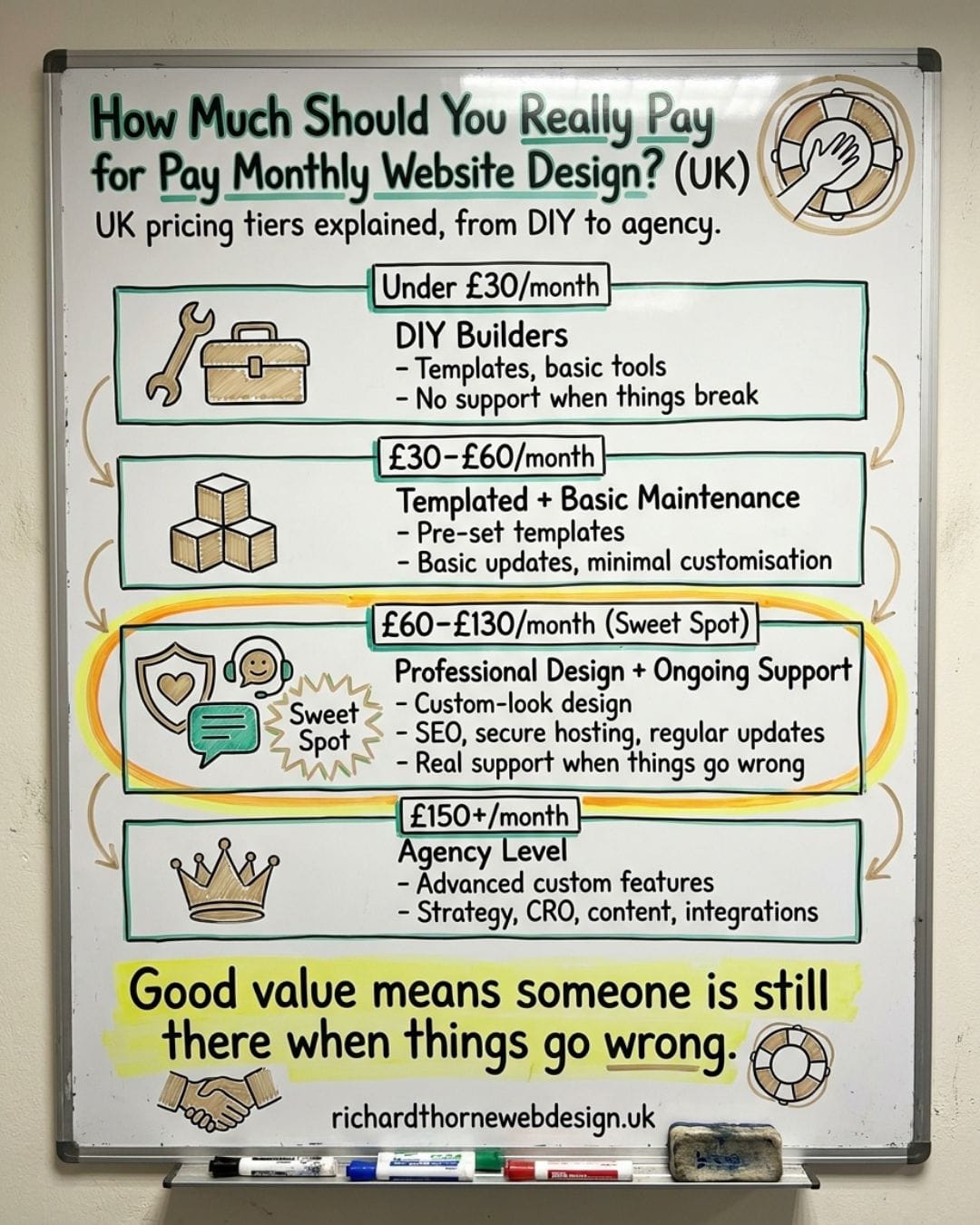
Under £30/month — usually a DIY builder subscription (Wix, Squarespace, or similar). You’re renting a tool, not hiring a designer. There’s no professional input, no meaningful support, and while platforms like Wix have improved their SEO tools in recent years, WordPress still offers significantly more control for serious rankings.
£30–£60/month — entry level for a professionally managed site. Providers including WebHealer and PocketSite sit in this range, with templated designs and basic maintenance. Serviceable, but limited in scope.
£60–£130/month — the sweet spot for most therapists and small businesses. A properly designed site with SEO foundations, hosting, maintenance, updates, and genuine ongoing support. This is where RTWD’s Pay Monthly plans sit: Pips at £59/month, Seedlings at £89/month, and Blossoms at £129/month.
£150+/month — agency-level pricing, often with account managers and larger teams behind the scenes. Justifiable for complex sites or businesses with significant online revenue. For most therapists in private practice, it’s more than you need.
For context: a one-off website build from a freelancer or small agency in the UK typically costs £1,500 to £5,000 upfront. After that, hosting, updates, and support are extra — unless you negotiate them in, which most people don’t.
The real question isn’t price — it’s value
Here’s something I think about with my own pricing. I know I sit at the more affordable end of the market for what I deliver. That occasionally makes me wonder whether it sends the wrong signal — whether “affordable” reads as “not very good.”
But the value of a web design service isn’t the number on the invoice. It’s in what happens after your site goes live.
If you asked me how to tell whether a web designer is giving you good value, I’d say: look at one thing first — are they still there?
A surprising number of designers build a site, collect the final payment, and disappear. You email them six months later because something’s broken, and either get no response or discover they’ve moved on entirely. As I once put it to a client, slightly less diplomatically: the real warning sign is when you spot your old web designer working at McDonald’s.
Beyond availability, look for these:
Response time. A designer managing ongoing monthly clients should be responsive. If emails regularly take days to arrive — or never get a reply — something’s not right.
Active maintenance. WordPress sites need regular upkeep. Plugins conflict, security patches arrive, themes update and occasionally break something. Without someone monitoring your site, you might not know the contact form stopped working until a potential client tells you.
Honest communication. Is your site generating enquiries? If you’ve had a professionally managed site for a year with no online contact, your designer should be raising that conversation with you, not waiting to be asked.
The hidden cost of cheap web design isn’t the low monthly price. It’s the cost of being on your own when something goes wrong.
Why the pay monthly model works — for both sides
I genuinely like the subscription model, and not just because it gives me steadier income.
Monthly plans change the nature of the working relationship. Instead of a large upfront project where both sides want it finished quickly so they can invoice and move on, there’s an ongoing partnership. Builds tend to be more considered. Clients feel less rushed. And there’s a natural incentive on both sides to make the site work well over time.
For clients, monthly pricing removes the biggest barrier: the assumption that a professional website means thousands of pounds before you’ve even started. For most therapists in private practice, £89 a month fits into a business budget in a way that £2,500 upfront simply doesn’t.
One honest aside: when I moved to the subscription model, I expected clients to send their content more promptly — they’re paying each month, so there’d be a natural incentive to get things moving. It hasn’t worked that way. Content still arrives in its own time. Therapists are busy people, and that’s entirely understandable. Just worth knowing if you’re planning a build.
RTWD was recognised at the Southern Enterprise Awards 2021 for Best Web Design Service Somerset — which is less about the accolade and more about the fact that quiet, consistent quality does get noticed.
If you’re weighing up your options, Do You Have to Pay Monthly for a Website? walks through all the alternatives honestly. And if you want to understand exactly what a pay monthly plan covers, What’s Included in a Pay Monthly Website Package? is a good starting point.
RTWD’s plans start from £59/month, with no long-term contract. The setup fee of £99 is currently waived for all new clients. If you’re trying to work out what’s right for you, I’m happy to have a straightforward 30-minute chat. Take a look at the plans here or get in touch.
Frequently asked questions
How much does pay monthly website design cost in the UK?
Pay monthly website design in the UK ranges from around £30 to £150 or more per month, depending on the provider, what’s included, and the complexity of the site. At the budget end (£30–£60/month), you’ll typically get a templated design with basic maintenance. In the mid-range (£60–£130/month), expect a professionally designed site with on-page SEO, hosting, regular updates, security monitoring, and genuine ongoing support. Agency-level monthly plans tend to start at £150 and above. For most therapists and small businesses, the £60–£130/month range delivers the best balance of quality, support, and value. It’s also worth comparing against the one-off alternative: a professionally built website from a UK freelancer or small agency typically costs £1,500 to £5,000 upfront, with hosting and maintenance costs on top.
Is pay monthly web design worth it compared to paying upfront?
For most small businesses and therapists, yes — particularly if cash flow is a concern. Rather than paying £1,500 to £5,000 upfront, you spread the cost into a predictable monthly payment that includes hosting, maintenance, and ongoing support. The key advantage isn’t just financial: pay monthly plans create an ongoing relationship with your web designer, which means someone is responsible for keeping your site working, updated, and secure. The alternative — a one-off fee for a build — often leaves you without support once the project is complete. The main consideration is longevity: over several years, monthly payments may add up to more than a one-off build. If you value flexibility and ongoing support, pay monthly usually wins. For a full breakdown of your options, see Do You Have to Pay Monthly for a Website?
What should be included in a pay monthly website design package?
A good pay monthly package should include the website build itself plus everything needed to keep it running properly. As a minimum, look for: domain registration and hosting, an SSL certificate, regular WordPress updates (core, themes, and plugins), security monitoring, offsite backups, and responsive support when you need changes or something goes wrong. Better plans also include on-page SEO setup, Google Business Profile guidance, legal pages (privacy policy, cookie consent), and contact or booking form integration. What often gets left out of cheaper plans is the support relationship — someone who’s actually there when your site breaks. Before signing up to any plan, check how support is provided and what the typical response time is. That tells you more about the real value of a plan than any feature list. See What’s Included in a Pay Monthly Website Package? for a full breakdown.
How do I know if my web designer is giving me good value for money?
The clearest sign of good value isn’t the monthly price — it’s whether your designer is actively looking after your site. A few things to check: Are they responsive when you have a question or problem? If emails regularly take days to arrive or go unanswered, that’s a warning sign. Is your site being kept up to date? WordPress sites need regular plugin and security updates — if these aren’t happening, your site is gradually becoming a security risk. Do you know who to contact when something breaks? A good pay monthly arrangement means there’s always a clear point of contact who takes responsibility. And critically: is your site generating enquiries? If you’ve had a professionally managed site for over a year with no online contact, it’s worth asking why — a good designer should be asking that question with you, not waiting to be asked.
Can I switch web designer if I’m on a pay monthly plan?
Yes, you can switch web designers on a pay monthly plan, though the process depends on your current arrangement’s terms. The main things to check: whether your domain is registered in your name (not your designer’s), whether you have access to your hosting account, and whether you can get a copy of your website files and database. Most reputable providers will transfer these if you choose to leave. Before signing up to any pay monthly plan, check the cancellation terms clearly — how much notice is required, what happens to your website when you leave, and who owns the domain. A trustworthy designer will be upfront about all of this. If a provider is vague about cancellation, that’s worth questioning before you commit.