
TL;DR: Local SEO is how you show up when someone nearby searches for a therapist. Google weighs three things: how relevant you are to the search, how close you are, and how well known you appear online. A complete Google Business Profile and consistent contact details across the web matter most.
If you have ever searched for your own practice on Google and found another therapist sitting above you, you will know the feeling. You are just as qualified, perhaps more experienced, yet someone else appears first when a potential client looks for help in your area. It can feel personal. It usually isn’t.
What you are seeing is local SEO at work. Local SEO for therapists is simply the set of things that decide which practices Google shows when someone searches for support near them, whether that is “counsellor near me”, “therapist Glastonbury”, or “anxiety counselling Somerset”. The reassuring part is that most of what influences it is practical, and most of it is within your control.
I learned this with my own business. RTWD’s Google listing sits at number two or three in the local results for my area, and it did not get there by accident. This article explains, in plain English, how Google decides who to show first, and the handful of things that genuinely make a difference.
What local SEO actually means for a therapist
SEO stands for search engine optimisation, which is a fancy way of saying “helping Google understand and trust your business”. Local SEO is the version of that focused on your area. It is what gets you into the local results, the little map with three listings underneath that often appears when someone searches for a service nearby. That section is usually called the map pack, and for a therapist it is prime space, because the people searching are almost always looking for someone they can actually see or speak to.
Unlike paid ads, you do not pay Google to appear there. You earn the spot by giving Google clear, consistent, trustworthy signals about who you are, where you work, and what you offer. The therapists who show up first are rarely the ones spending the most money. They are usually the ones who have quietly got the basics right.
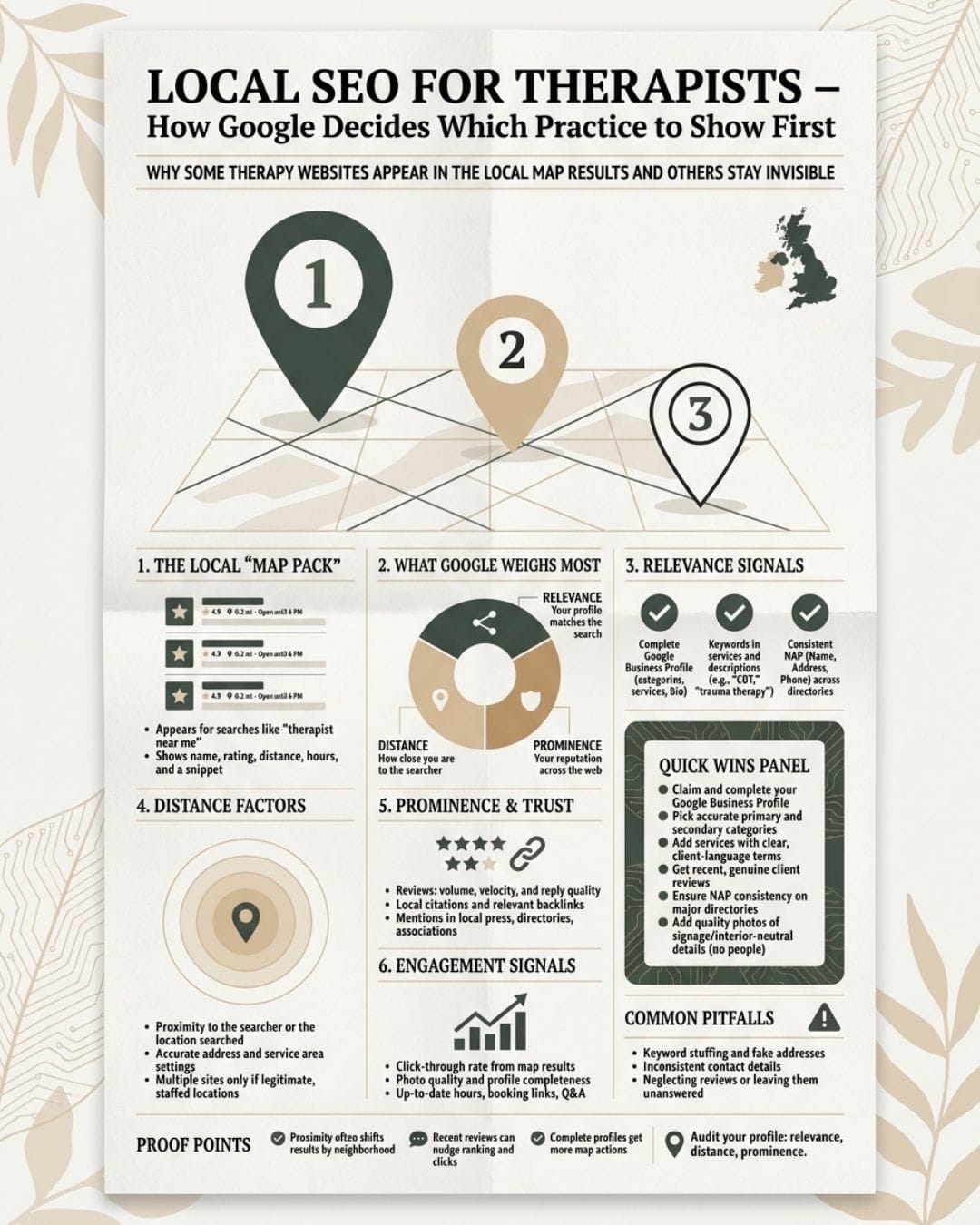
The three things Google weighs
Google has been fairly open about how it ranks local results. According to Google’s own guidance, three main factors decide the order: relevance, distance, and prominence. Understanding these three takes the mystery out of the whole thing.
Relevance is how well your profile matches what someone is searching for. If a person searches for “couples counselling” and your profile only mentions general therapy, Google has less reason to show you. The more accurately your profile and website describe the work you actually do, the more relevant you become for the right searches.
Distance is how close you are to the person searching, or to the place named in their search. You cannot change where you are, but you can tell Google clearly which areas you serve, which helps for nearby towns as well as your own.
Prominence is how well known and well regarded your practice appears to be. This is the one most therapists overlook, and it is where citations, directory listings, reviews, and links from other websites all come in.
Your Google Business Profile is the foundation
Everything in local search starts with your Google Business Profile. It is the free listing that feeds the map pack, and without it you simply cannot appear there. If you have not set one up yet, or you set one up years ago and have not touched it since, that is the first place to look. I have written a full, practical guide to setting up a Google Business Profile as a therapist, including how to keep your home address private, which I would read alongside this article.
For local ranking, the profile does a lot of heavy lifting. It tells Google your categories (which feed relevance), your service area (which feeds distance), and it gathers your reviews and photos (which feed prominence). Get the profile right and you have built the foundation everything else sits on.
Citations and directories: getting your details out there
A citation is any place online that mentions your business name, address, and phone number, even if it does not link to your website. Every citation is a small vote of confidence that tells Google you are a real, established practice. They are a big part of the prominence signal.
When I built RTWD’s local presence, I listed the business across a range of UK directories and platforms: Yelp, Somerset Live, The Manifest, and the usual social media profiles among them, alongside other backlinks built up over time. None of these on its own is dramatic. Together, they add up to a clear, consistent picture of a business that genuinely exists and operates where it says it does.
For a therapist, the practical version is straightforward. Get listed on a sensible spread of reputable UK directories and local sites, make sure your profile on each is complete, and you steadily strengthen the prominence signal that helps you climb the local results.
NAP consistency: the small detail that quietly decides it
This is the part most people miss, and in my experience it is one of the most important. NAP stands for Name, Address, and Phone number. The rule is simple: those three details must be exactly the same everywhere your practice appears online.
It sounds trivial, but it matters more than almost anything else at the citation level. If your phone number is written one way on your website, another way on Yelp, and your address says “St” in one place and “Street” in another, Google cannot be certain these listings all refer to the same business. That uncertainty quietly holds you back. When the details match perfectly across the board, Google can join the dots with confidence, and confidence is what gets you ranked.
Making sure those details are identical wherever a therapist appears online is one of the core jobs of any local SEO service worth its fee. It is unglamorous, detailed work, but it is often the difference between a listing that ranks and one that drifts.
Therapist directories: leads and authority
The big therapist directories, Counselling Directory, Psychology Today, and the BACP register among them, are worth being on for two reasons. First, they are a genuine source of leads in their own right, as plenty of clients search them directly. Second, they are authoritative, well-established websites, so a listing there acts as a strong citation and backlink pointing to both your website and your Google listing.
The honest caveat is that these directories are crowded. There will be a great many therapists listed alongside you, so you should not rely on them as your only route to being found. Think of them as one solid pillar of your prominence, working alongside your own website and Google profile, rather than the whole strategy. If you want the wider picture, my guide to getting found on Google as a therapist pulls these threads together.
What actually moves the needle
If you are short on time and watching every penny, here is where I would put your effort, in order.
- Set up and complete your Google Business Profile. Accurate categories, a service area, photos, and a link to your website. This is non-negotiable and it is free.
- Fix your NAP consistency. Write down your name, address, and phone number exactly as they should appear, then make every listing match it. This costs nothing but attention.
- Build a sensible spread of citations. A handful of reputable UK directories plus the main therapist directories. Quality and consistency beat quantity.
- Keep your profile active. An occasional post, the odd new photo, and a calm reply to any reviews.
What is overrated? Chasing dozens of low-quality directory listings for the sake of a number, obsessing over keywords stuffed unnaturally into your profile, and paying for anything that promises an overnight jump to the top. Local SEO is a slow, steady build. Done properly, it keeps working for you for years.
Frequently asked questions
What is local SEO for therapists?
Local SEO for therapists is the practice of helping your business appear when someone nearby searches for the kind of support you offer. It covers your Google Business Profile, the consistency of your contact details across the web, your listings on directories, and links from other websites. The aim is to appear in Google’s local map results and the organic listings for searches like “counsellor near me” or “therapist” plus your town. Unlike paid advertising, you do not pay Google for these positions. You earn them by giving clear, consistent, trustworthy signals about who you are, where you work, and what you do, which is largely within your own control.
How does Google decide which therapist to show first?
Google weighs three main factors: relevance, distance, and prominence. Relevance is how well your profile and website match what the person searched for. Distance is how close you are to the searcher or the area they named. Prominence is how well known and well regarded your practice appears, based on reviews, citations, directory listings, and links from other sites. You cannot change your distance, but you have real influence over relevance and prominence. A complete, accurate Google Business Profile improves relevance, while consistent listings and genuine reviews build prominence over time. The therapists who rank first have usually got these basics right rather than spent the most money.
Do directory listings help a therapist rank on Google?
Yes, when they are done well. Each listing that mentions your business name, address, and phone number acts as a citation, a small signal to Google that your practice is real and established. Listings on authoritative sites such as Counselling Directory, Psychology Today, and reputable UK directories carry the most weight, and they often bring direct enquiries too. The key is consistency: your details must match exactly across every listing, or the benefit is lost. Avoid the temptation to chase dozens of low-quality directories for the sake of a number. A sensible spread of trusted, complete listings does far more good than a long list of thin, inconsistent ones.
What is NAP consistency and why does it matter?
NAP stands for Name, Address, and Phone number, and consistency means those three details appear exactly the same everywhere your practice is listed online. It matters because Google uses these details to confirm that all your listings refer to the same real business. If your phone number or address is written differently from one site to the next, Google cannot be certain, and that uncertainty quietly holds your ranking back. When everything matches perfectly, Google can connect your website, Google profile, and directory listings with confidence. Tidying up NAP consistency is unglamorous, detailed work, but it is one of the highest-value things you can do for your local search visibility, and it is one of the core jobs of any good local SEO service.
Can I do local SEO myself, or do I need to pay someone?
Much of it you can do yourself. Setting up your Google Business Profile, choosing accurate categories, adding photos, and making sure your contact details match across your website and main directories are all within reach of anyone willing to spend a little time. Where a professional helps is in the detailed, repetitive work: auditing every place your business appears, fixing inconsistencies you would never think to check, building citations on the right sites, and keeping it all current. If you are time-poor or would simply rather it was handled properly, paying for a local SEO setup is reasonable. If you have the time, the steps in this article will take you a long way on your own.
How long does local SEO take to work?
It is a steady build rather than an overnight change. Setting up your Google Business Profile can start showing results within a few weeks, but the real gains in prominence, from citations, consistent listings, and reviews, accumulate over months. Anyone promising you the top spot in days is not being straight with you. The upside is that, once you have done the work properly, it tends to keep paying off for a long time with only light maintenance. Think of it less as a campaign with an end date and more as quietly tending your presence so that, when someone in your area needs support, you are the one they find.
If you would like someone to look over your local search presence, check your contact details are consistent everywhere, or set the whole thing up for you, feel free to book a free 30-minute chat. I am happy to take a look and point you in the right direction.
Richard Thorne is a web designer based in Glastonbury, Somerset, specialising in websites for therapists and counsellors. RTWD was named Best Web Design Service in Somerset at the Southern Enterprise Awards 2021.