
If you’ve ever gone looking for advice on marketing your therapy practice, you’ll know the problem. There’s too much of it. Post daily, start a podcast, build a funnel, learn ads, be everywhere at once. It’s enough to make you close the laptop and decide word of mouth will have to do.
I understand that feeling. I’d rather get on with the work I enjoy and ignore marketing.
But here’s the thing I’ve learned after years of building websites for therapists and counsellors. The practices (and webbie guys) that get found don’t do more than everyone else. They do a few quiet things properly and then leave them to work. Most of the noisy advice is optional. These five aren’t.
Why most marketing advice overwhelms therapists
Most marketing advice is written for people who enjoy marketing. It assumes you’ve got spare hours, a thick skin, and an appetite for being visible. For a thoughtful therapist who’d rather be with clients, that advice doesn’t just feel like a lot. It feels like the wrong life.
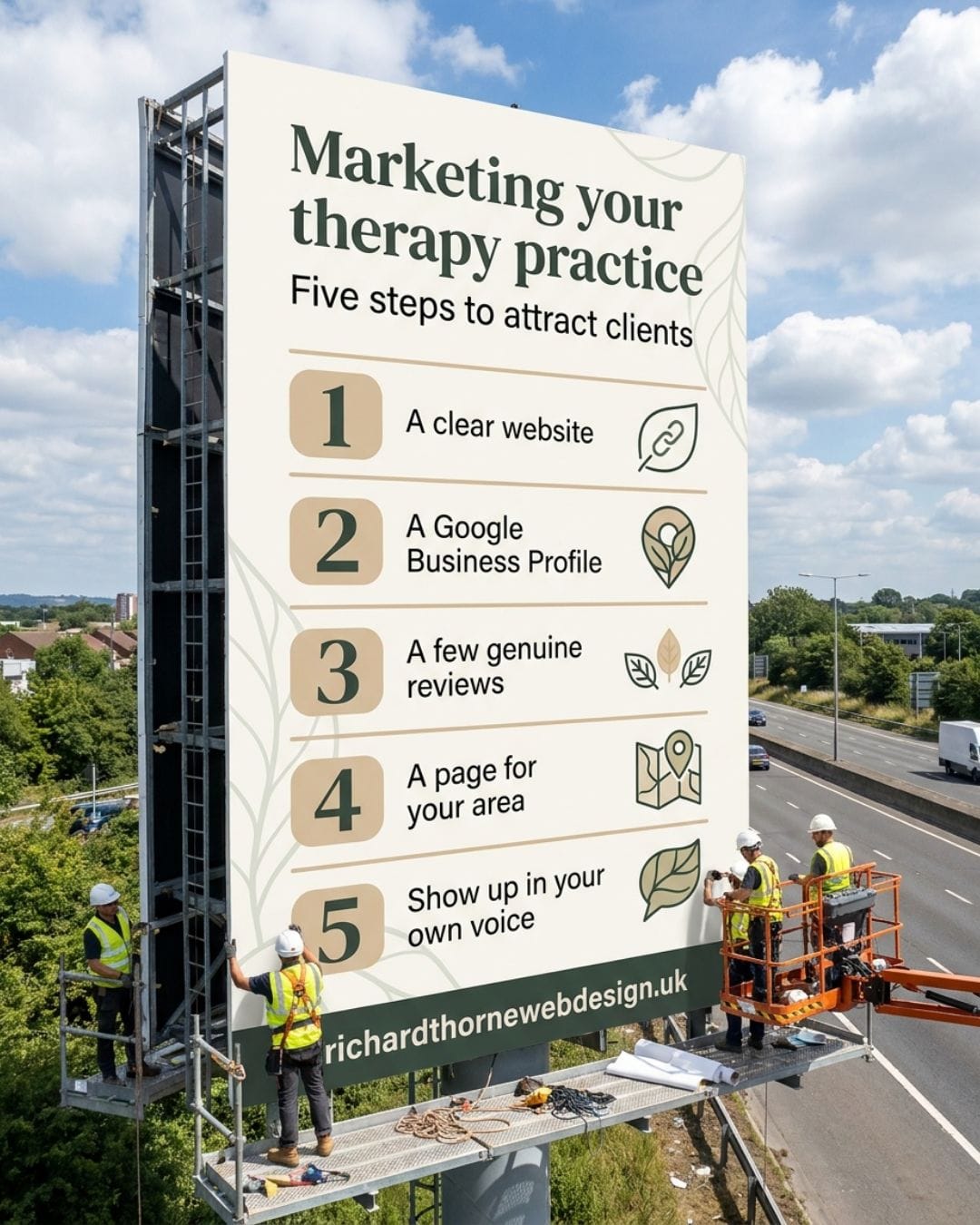
So the list grows, the guilt grows, and nothing actually gets done.
The way out isn’t to try harder. It’s to do less, but to do the right less. A small number of things genuinely move the needle for a local practice. The rest is noise you’re allowed to ignore. Once you know which is which, the whole thing gets quieter and a great deal more doable. That’s what the next five sections are: the short list worth your time.
1. A clear website that says who you help and where
Everything else points back to your website, so this is where the work starts. Not a clever website. A clear one.
When someone lands on your site, they should know within a few seconds who you help, what you help with, and where you’re based. That’s it. So many therapy websites open with a quote about the journey of self-discovery and never quite say “I’m a counsellor in Taunton who helps people with anxiety.” The visitor has to dig, and most won’t. If you want a fuller look at this, I’ve written about what a therapist website actually needs (and what it doesn’t).
Clarity is the kindest thing you can offer an anxious person trying to decide whether to get in touch. Say plainly who you’re for. Name the problems you work with. Make your location and how to contact you obvious. A clear website quietly does the persuading, so you don’t have to.
2. A Google Business Profile so local clients can find you
Once your website is clear, the next job is making sure people can actually find it. For a local practice, that starts with a free Google Business Profile.
When someone searches “counsellor near me” or “therapist in Wells”, Google leans heavily on Business Profiles to decide what to show on the map and in local results. Google’s own guidance confirms it ranks local results on relevance, distance and prominence, and that complete, consistent information helps. No profile, and you’re often simply not in the running, however good your website is. It’s one of the highest-value half hours you’ll ever spend on marketing, and it costs nothing.
Fill it in properly. Correct name, address and phone number, matching exactly what’s on your website. Choose the right category, add your hours, write a couple of honest sentences about what you do. Then keep it ticking over. There’s more detail in my guide to whether your Google Business Profile actually helps clients find you. It works in the background while you get on with seeing clients.
3. A few genuine client reviews
Here’s something that stuck with me. I work with a coach who has skill, years of experience, and glowing testimonials coming out of their ears. The proof of how good they are sits there, quietly unused, while the business doesn’t go where it should.
That’s the lesson. Reviews are the most persuasive marketing you’ll ever have, and they’re the bit therapists most often leave on the table.
A handful of genuine reviews, on your Google Business Profile and your website, do the convincing that you’d feel awkward doing yourself. They answer the quiet question every new client is asking: can I trust this person? You don’t need dozens. You need a few honest words from people you’ve genuinely helped. The hardest part is simply asking, and most happy clients are glad to, if only you’d let them.
4. A page for your area and the work you do
This is the one most therapy websites are missing, and for years I didn’t push it with clients the way I should have. I do now.
If you want to be found by people searching in your town, you need a page that’s genuinely about working in that town. It’s the single page most therapy sites don’t have, and I’ve written separately about the one page your therapy website needs to rank locally. A counsellor covering Glastonbury, Street and Wells is far better served by a clear page for each than by one “Areas Covered” line in the footer. The same goes for the work itself. A proper page on anxiety, or grief, or couples work, helps the right person feel you’re speaking directly to them.
People rarely search for your modality. They search the problem and the place: “help with anxiety in Somerset”. It’s worth understanding what your clients are actually searching for. Give them a page that quietly matches what they typed, and you become the obvious answer. This is the heart of local SEO for therapists.
5. Showing up consistently, in your own voice
The last one isn’t about doing more. It’s about being recognisably yourself, a little and often, rather than loudly and not at all.
You don’t need to post every day or perform online. A short, honest article now and then, answering a question clients actually ask you, does more than a burst of frantic activity followed by silence. Steady and genuine beats loud and sporadic every time. What matters most is that it sounds like you, because the reason so much marketing feels fake is that it doesn’t sound like the person behind it.
This is the part that stalls people, usually for lack of time rather than lack of ideas. If putting yourself out there fills you with dread, you’re not alone, and I’ve written honestly about marketing for therapists who hate marketing. These days the time problem is solvable too. Content can be created for you, or shaped with AI but kept in your own language, so it still sounds like you, just without the evenings lost to a blank screen.
If you only do one thing, start here
If all five feels like a lot, don’t try to do them at once. Pick the foundation and build out from there.
- Make your website clear about who you help and where. Everything else points back to it.
- Set up or tidy your Google Business Profile.
- Ask two happy clients for a short review.
- Add a proper page for your main town or your main area of work.
- Write one honest post, or get help writing it, in your own voice.
That’s a few quiet afternoons of work, not a personality transplant. And unlike the noisy advice, every one of these keeps working long after you’ve done it.
A gentle next step
If you care a great deal about your work and very little about shouting about it, this is exactly the kind of marketing that suits you. Quiet, honest, and built to keep working while you do the thing you’re actually good at.
You don’t need to do all of it alone. Helping therapists get found locally, in words that feel like theirs, is the work I’m building with GrowPath. If you’d like to be found by the people in your area who already need you, you can take a look at GrowPath and pop your name on the list.
(For a bit of background: RTWD was named Best Web Design Service in Somerset at the Southern Enterprise Awards 2021. The part I care about, though, is helping good people get found.)
FAQ
What’s the most effective way to market a therapy practice?
For a local practice, the most effective marketing is quiet and foundational rather than loud and constant. Start with a clear website that says exactly who you help, what you help with, and where you’re based. Add a free Google Business Profile so you appear when people search locally, and gather a few genuine reviews to do the reassuring for you. Then add a proper page for your town and your main area of work, so searches like “anxiety counsellor in Somerset” find you. These few things keep working in the background while you see clients, which is what makes them so much more effective than sporadic bursts of social media. Most therapists overestimate how much they need to do and underestimate how much these foundations carry. Do the simple things properly and you rarely need the noisy tactics at all.
How much time does marketing a therapy practice actually take?
Less than most people fear, if you focus on the right things. The foundations, a clear website, a Google Business Profile, a few reviews and a couple of local pages, are mostly one-off jobs. You set them up well once and they keep working without daily effort. That might be a few quiet afternoons in total. After that, ongoing marketing can be as light as one honest article or post now and then, written when you feel like it rather than to a punishing schedule. The mistake is believing you must post every day to matter. You don’t. Steady and genuine beats loud and sporadic. If even the occasional article feels like too much, that part can be created for you or shaped with AI in your own voice, so consistency doesn’t depend on you finding the time.
Do I need social media to market my therapy practice?
No, not as your foundation. Social media can help, but it’s the least reliable place to build a practice on, and it’s the part that drains thoughtful people the fastest. People looking for a therapist are far more likely to search Google than to scroll for one. That’s why a clear website, a Google Business Profile and a few strong local pages matter more than any posting schedule. Get those right first. If you enjoy the occasional post, treat it as a gentle extra rather than the main event. And if social media fills you with dread, you have full permission to do very little of it. Being genuinely findable when someone searches for help is worth far more than being constantly visible to people who aren’t looking yet.
How do therapists get more clients without feeling salesy?
Lead with clarity and usefulness instead of persuasion. Most of the “salesy” feeling comes from tactics that don’t suit you: hype, pressure, false urgency. Drop all of it. If your website honestly explains who you help and what it’s like to work with you, and your Google Business Profile and reviews quietly back that up, the marketing does its job without you ever having to push. Therapists are trained to spot inauthenticity, and so are the people looking for one. The warm, plain, honest approach isn’t only more comfortable for you, it’s the only one that genuinely works with this audience. You’re not convincing anyone of anything. You’re simply making it easy for people who already need your help to recognise that you’re a good fit and to get in touch.
What should a therapy website include to bring in clients?
At a minimum, it should make three things obvious within seconds: who you help, what you help with, and where you’re based. Beyond that, a few things quietly do the heavy lifting. Clear pages for your main areas of work, so the right person feels you’re speaking to them. A page for your town or area, so local searches find you. Genuine reviews, to answer the trust question every new client is silently asking. An easy, obvious way to get in touch, without hunting for it. And honest, plain writing that sounds like you rather than an advert. You don’t need clever design or endless pages. You need a clear, trustworthy site that does the reassuring on your behalf, so an anxious person can decide, with confidence, that you’re the right person to contact.